 by C.T. Hutt
“I feel that there is nothing more truly artistic than to love people”
Vincent Van Gogh
“The secret of art is love.”
Antoine Bourdelle
Is there anything so difficult to define, analyze, or discover for ourselves as that most ethereal of human emotions, love? Its definitions vary for all of us, but many of us experience it, recognize it in others, and know that it is a great part of ourselves, perhaps the greatest. It is little wonder that this rather nebulous subject is often at the center of great artistic works. Many can recognize the tragedy of Shakespeare’s play Romeo and Juliet, the warm tones and simple beauty of Gustav Klimt’s painting The Kiss, the immortal drama of Humphrey Bogart and Ingrid Bergman in Casablanca, or the casual free flowing tunes of the Beatles’s All You Need is Love. These great works have captured something truly essential about the human experience of love, and for that they will always be remembered and cherished. But what of our young medium? Where is our undying masterpiece? Here’s a look at what we have so far:
Mario, Zelda, Prince of Persia, Super Ghouls and Ghosts etc.
Life is good, some terrible lizard/dark wizard/grand vizier kidnaps your significant other and puts legions of baddies and dire puzzles in your path. You are on a quest to get them back. Ever since Donkey Kong couldn’t keep his hands to himself, this well-worn love story has been a video game staple. A protagonist needs a reason to head out his or her front door and a kidnapped lover seems like a pretty clear one. From a writing standpoint this approach to a plotline is extraordinarily easy. The love between the characters is present throughout the entire game, but never has to be developed because they never spend any time together. In the end the two lovers smooch, cake is exchanged (wink), and all is well. This depiction of love in video games is childish and easily forgotten; it’s meant to be.
Max Payne, Gears of War 2, The Darkness, etc.
Life is good, some terrible crime lord/horde of gun-toting orcs/shadowy government organization kills your significant other and puts legions of baddies and dire puzzles in your path. You are on a quest to kill them, kill them all. Again, love here is not being used as a centerpiece of a great work, but rather as a moral excuse for letting the protagonist pull the trigger several thousand times. While there is certainly some truth in the idea that a lost love can be a powerful motivator for personal change and that tragedy walks hand in hand with the desire for destruction and revenge, these philosophical considerations are almost universally lost in video games. I will grant that in its noir-tastic dialogue the Max Payne series does a fairly artful job of addressing the sort of self-destruction inherent in a revenge story, but such musings are drowned out by constant gunfire. The plotlines of these games and their portrayal of love are often laughable no matter how much fun it is to shoot gangsters.
Baldur’s Gate, Star Wars: Knights of the Old Republic 2, Mass Effect, The Witcher, Fable
Role Playing Games have a distinct advantage in portraying the full pallet of human emotions, including love. Unlike more action oriented games, RPG’s constantly ask us to pause and consider our actions before deciding on the best course. In battle, this means selecting the optimum plan of attack, in plot, this means talking with non-player characters and choosing your words carefully. When selecting dialogue options to progress the story, some developers have chosen to add romantic plotlines to the mix. I believe that this approach to portraying love in video games shows great promise. By utilizing the medium’s most definitive characteristic, interactivity, as a method of exploring romance and all the glories and pitfalls therein, I think that developers have a better chance of portraying love in a unique way.
However, this approach is not without its drawbacks. In The Witcher, the player’s avatar can choose to pursue a monogamous relationship or to enjoy a romp with as many NPCs as possible. Sexual congress in the game is symbolized by tarot card-like pictures which can lead to a rather adult themed “Gotta catch ‘em all” mentality in the gamer which I feel devalues its attempts to portray serious relationships. Similarly in Baldur’s Gate 2: Shadows of Amn and KOTOR 2 only one romantic relationship can be successfully realized per play through. By playing through the game multiple times the main character can explore all possible relationships. Again, I feel this detracts from the writers’ and developers’ attempts to express the drama of serious love in relationships. Of course, in the real world there are many fish in the sea and love is terribly complicated, but by allowing such a variety of relationships in a single game developers lose their control of the story. While I think this approach has great potential, for the time being I think it makes video games feel less like Orpheus and Eurydice and more like Leisure Suit Larry.
Final Fantasy
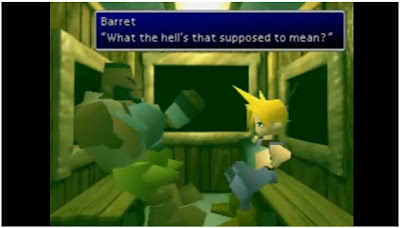
In terms of RPG’s with static storylines, the Final Fantasy series has long occupied a place of prestige . While there is no continuous plotline in this iconic series, a gamer can always be certain to see two things: an airship and a love story. And while the translations may be mediocre and the characters may be overblown, I have to give the series its proper due in terms of the variety of love stories it incorporates. In some cases characters with opposing personalities wind up together (FFVIII), in some love is lost early on only to be found again later (FFVII), in still others love is tragically split apart in the end (FFX (admittedly it is recovered in the abominable FFX-2)). The stories are reasonably engaging and the games built around them are great fun. Still, I don’t think any of the series has produced a real showstopper. Perhaps it’s only a matter of time until they do.
Shadow of the Colossus
Shadow of the Colossus is one of the blue ribbon babies for those who see video games as art. Whenever naysayers claim that the medium is nothing more than a vehicle for petty entertainments we can point at Sony’s 2005 release and say, “In your face, my good sir.” In addition to being visually stunning and fun to play, Shadow of the Colossus centers around a touching, albeit tragic, love story. With his true love at death’s door the protagonist overcomes impossible odds striving to bring her back. As the game progresses it becomes evident how much this quest will cost him as the man he was morphs into a twisted personification of his own grief and pain. I believe that the only reason Shadow of the Colossus is not widely recognized as great art is because of the stigma surrounding the video game medium. Truly, it was ahead of its time. Perhaps, as video games spread to a greater proportion of the populace this game will receive the recognition I believe it deserves. Time, I suppose, will tell.
As the artistic medium of gaming continues to evolve I imagine that more developers, both independent and incorporated, will begin to more fully realize the awesome potential that video games have to express truth about the human condition. With that realization I am sure we will see more titles that use love and relationships not just as motivations or side notes but as central themes.


 It hit me while I was playing God of War, marveling at some of the great design decisions and the intricate, incredible dungeon of the Temple of Pandora. It was new and familiar at the same time, and I could see how it spawned a whole category of action games at the same time as it drew on Zelda to create one of the most complicated dungeons I'd ever seen. I wondered how it was that I’d never played it before, and gloried in the fact that I finally could. God of War is a piece of video game history now, and while it may not be a long history, there are plenty of games worth revisiting.
